


Finding our spot: There were many areas in the design building that had potential, but what caught our eye the most was this HVAC piping!
Advantages:
-
Three-Floor Viewing Capability
-
Eye-catching “Architecture” with high potential for creativity
-
270 degree projection mapping ability
Considerations:
-
No access on bottom floor
-
Smaller piping obstacles
Goals:
-
Utilize the geometry of the present elements.
-
Encourage people to experiment and continually play with the interaction.


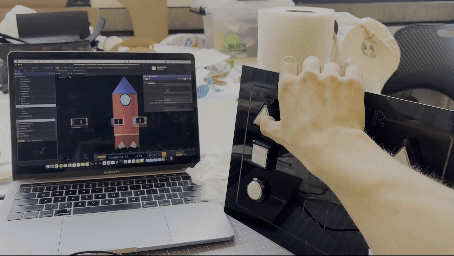


Prototyping: To ensure seamless immersion, we engineered custom truss mounts and themed enclosures that concealed the dual-projector hardware within the architecture. We utilized an iterative prototyping process for the control panels, perfecting the complex Arduino integration on a single unit before scaling to the full collaborative system.
The Solution: A collaborative rocket launch simulation projection-mapped onto existing architectural infrastructure (a large pipe).
-
The Interface: A gamified assembly system where 1–3 users must cooperate to build a rocket.
-
The Constraint: Users race against a countdown clock, forcing rapid negotiation and collaborative decision-making to meet mission specs.
Key Takeaway: This project demonstrated how digital projection mapping can turn passive architecture into an immersive interface, driving social interaction and cooperative problem-solving in public spaces.


Rocket Project
October 2024 - November 2024 | Team: Fin Taylor, Kyle Raleyea
The Challenge: We were tasked with designing an architectural augmentation for the College of Design Public Spaces using some combination of digital technology to create an enjoyable interactive experience in this space.